For some reason, I'm reminded of an incident that took place about one month ago. I was in Mokopane, my shopping town, after school one day. I went to the bank because I had to pay the deposit for a backpackers lodge in advance of the trip I'll be taking along the coast this December holiday.
I went to the bank, waited in line, told the lady bank teller what I needed to do, completed the transaction, and left. I also saw another PCV's Principal there and greeted her. In any case, I didn't think much of the situation until the next time I saw that PCV, whose Principal I'd seen at the bank. I guess her Principal had recounted the following story to her:
She had seen me at the bank, and then I left. Once I was gone, the bank tellers began talking to each other in SePedi. They were confused: I had actually been NICE to them. They were amazed by this! The Principal had to explain to the tellers who I was and where I'm from. The bank tellers replied with something to the extent of, "I knew something about him was different--he actually treated me like a human being."
I find the fact that she actually had to explain WHY a "white" person would treat a black person like a human being says a lot.
The other reason I'm writing this entry is to update on my Life Skills group. Last Friday, on World AIDS Day, I met up with them; we went to the Clinic in the village and all got tested. All in all, I got tested with 5 boys and 7 girls (only a few of them couldn't make it). It felt great to do at least that much; none of them had been tested before, and some of them were VERY nervous based on past risky behavior.
After everyone was done with their test (it was the rapid test, so they all knew their results), the Clinic Sister called me in to her office (they call Nurses "Sisters" at the Clinic). She was impressed with what I'd done; she actually took off the VCT pin she was wearing and gave it to me. It was a huge surprise, and I really appreciate it.
The following day, I went with the Life Skills group on a day-trip to celebrate the end of our training and the HIV test. We went to Waterland in Polokwane, which is a "waterpark"--I use quotes because it's just 3 small pools and one slide that doesn't work. We had a great time, though. We spent the day swimming, relaxing, braai-ing (South African barbeque), and dancing to popular Kwaito and house music.
One song that I heard a lot that day is called "Sistah Bettinah"--I heard it at least 15 times throughout the course of the day. Everyone loves it! It is a ridiculous song! It is simultaneously catchy and stupid (and, to me, annoying!) I can think of it as the South African "Hollaback Girl."
The day was great, though, and we all had a fantastic time. I think it was a fitting way to cap off the year.
The 2006 school year is over, and now I have four and a half weeks of vacation to look forward to. I leave on Saturday for Cape Town, Plettenberg Bay, Jeffreys Bay, East London, Cintsa, Port St Johns, and Durban. I can't wait!
Thursday, December 07, 2006
Tuesday, November 28, 2006
THANKSGIVING
Last week I, along with many of my PCV friends, went to Pretoria for Thanksgiving at the Ambassador's House. It was great to see everyone again, to get away from the village for a few days (end of the year...not a lot going on in the schools...lots of boredom). And the Thanksgiving feast itself was amazing. The Ambassador actually had Butterball turkeys flown in from the States for the meal!
While in Pretoria, I also had the fortunate opportunity to watch the movie BORAT....and wow. I'd always been a fan of the character from the Ali.G show, but this took it to a whole new level.
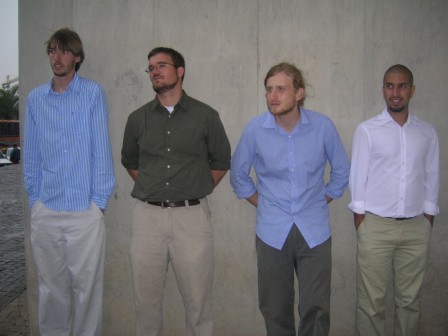
Here is a picture of my friends Tom, Seth, Dan and I (in height order!) that I stole from my friend Cait's blog.
While in Pretoria, I also had the fortunate opportunity to watch the movie BORAT....and wow. I'd always been a fan of the character from the Ali.G show, but this took it to a whole new level.
Here is a picture of my friends Tom, Seth, Dan and I (in height order!) that I stole from my friend Cait's blog.

Wednesday, November 22, 2006
LIFE SKILLS

Top Row: Bernard Luvhimbi, Thabo Chuma, Michael Mashabane, Eulenda Masingi, Macdonald Ngobeni
Middle Row: Rosina Nkuna, Letticia Tshabalala, Tsakane Kubayi, Tinyeko Masingi, and Me
Bottom Row: Wilson Hlangwini, Lizzy Mathobela, Benjamin Baloyi, Dikeledi Matjabela, Iris Nyalungu
Quite possibly the most personally satisfying thing I have done in South Africa has been my Life Skills group. In a previous entry, I mentioned that I'd been planning an after-school group with local high school kids. Planning the thing was a lot more work than I had planned!
First I had to create a schedule for my group; I created this using the Peace Corps Life Skills Manual, and I brought it to my meetings. My plan was as follows: there are two high schools in my village. I wanted to work with a small group of committed 10th and 11th graders from both high schools. So first I went to Somavugha High School and met with the principal. Once I had his permission, I was able to meet with the Grade 10/11 teachers and present my plan to them. Then I had them select a list of their best male and female students, and I arranged to speak with these students. I invited the students to my first session. Finally, I arranged to have access to a classroom after school, from 3-5pm, Mondays and Thursdays, with chalk and a "duster." Then, I went to Ben Hlongwane High School and did the exact same thing.
The entire planning process took weeks, and it kept me occupied for most of August. I often had to schedule meetings when both I and the other parties were available, which wasn't always easy. Sometimes, unexpected events like dying students caused other delays (here, they refer to that as a "death case")
Eventually, in early September, I had my first Life Skills session, on a Thursday, from 3-5pm, at Ben Hlongwane High School. A total of 28 students from both schools showed up, out of the 40 I'd invited.
And so we began the Life Skills training. It took 17 sessions over the course of 9 weeks for a total of 34 after-school hours. It was a lot of fun, but took a lot of planning and preparation. Over the course of those 9 weeks, the 28 students shrank to 14, but those final 14 who finished my training are great kids, dedicated, and just a pleasure to work with. (Other kids dropped out due to a variety of circumstances; for example, one of my favorite students dropped out because she got pregnant. I guess she was missing some crucial life skills! Other students couldn't follow my no-unexcused-absence policy, and after 3 unexcused absences, I kicked them out)
The sessions themselves were great. There were skits, role-plays, dramatizations, games, contests, etc. There were condom demonstrations with bananas. There were lots of group activities, lots of discussions, and a lot of debate and disagreements. I introduced a lot of new concepts to these kids, but i didn't come with all of the answers. They had to figure things out for themselves.
We discused our role models, alcohol and drug abuse, a lot of HIV/AIDS topics (facts and myths, effects on the immune system, transmission, prevention, and disease progression). We had a lot of lively discussions around the topic of gender and culture, especially when related to the spread of HIV in South Africa. We discussed risky behavior, communication skills, assertiveness, peer pressue, and self esteem. The purpose of the whole Life Skills training was to turn these kids into community peer educators, and so we ended our training with sessions on how to support responsible behavior, and how to deal with problems when facilitating group discussions.
I set out to empower a small group of kids to become peer educators and to in turn empower others in the community, and in that respect, I think that the training was a huge success. These kids, the 14 who finished, are incredibly bright and dedicated, and some of their plans for how to assist the community are really ambitious. First up: they will start mentoring 5th, 6th, and 7th graders in the primary schools, who are a very high-risk age-group. ("So young?" you ask. Well, sexual activity does begin earlier here)
These kids will stick by their beliefs and serve as role models; at our last session I told them that World AIDS Day is approaching; I would like to go and get tested with anyone who would like to join me. I was pleased when EVERY SINGLE STUDENT raised his or her hand. We'll see if it actually happens on 1 December, but if past behavior is any indication, then they will all keep their word and be there with me. I really hope it works; the stigma of getting tested is still huge here. If you go to get tested, it's obviously assumed that you have AIDS. But if "the American" and some of the best kids in the village get tested....well, maybe some minds will change.
In summary, this was about them, not me. I'd like to thank each of them. So....to Macdonald Ngobeni, Dikeledi Matjabela, Bernard Luvhimbi, Wilson Hlangwini, Lizzy Mathobela, Michael Mashabane, Tinyeko Masingi, Tsakane Kubayi, Benjamin Baloyi, Eulenda Masingi, Thabo Chuma, Letticia Tshabalala, Rosina Nkuna, and Iris Nyalungu....thank you.
Friday, November 17, 2006
MST
It's been a long time since I've written, and a lot has happened. I could write a lot right now, but I'd like to mention two things quickly: my Life Skills Training (see next entry) and our Mid Service Training.
Mid-Service Training (MST) happens after Peace Corps Volunteers (PCVs) have been at site for one year. SA 14 (the 14th group of PCVs in South Africa, of which I am a member) education volunteers all arrived at our sites on 13 October 2005, and on 23 October 2006 we had our MST. It was great to see my fellow PCVs; many of us had not seen each other in many months, and some of us had not seen each other since IST in early March.
MST served, for us, as a recap after one year at site. We were able to hear each others' stories, successes, and frustrations. We got tips and helpful ideas to take back to our sites.
 For me, though, the best part of any training is always the chance to reconnect with my friends, and MST was great. It was held in Rustenberg, at a nice resort called the Oasis. It had 18 holes of mini-golf, squash and racquetball courts, a trampoline, tennis courts, and a pool with a waterslide. Needless to say, we all enjoyed ourselves! And the food was amazing as well.
 Since MST happened to (nearly) coincide with Halloween, we all held a Halloween party during the last night of MST. I organized it with my friend Tom, and it was a success! There were a lot of very interesting costumes. For my own costume, I decided to go as "white trash." I was thinking of portraying a Southern redneck, so I had my friend Cort cut off my hair (which I'd been growing for 11 months into a very impressive 'fro---I was very sad to see the hair go) and shave off my beard into a moustache. My hair was cut into the most ridiculous mullet we could think of. I put on a WWE t-shirt with the sleeves cut off and some very short denim shorts, aviator sunglasses, fake tattoos...and voila! I was "Billy Ray." Although once the transformation was complete, I was told that I looked like an Italian from New Jersey. Ah well.......
Saturday, September 16, 2006

Friday, September 08, 2006
NEW SLANG
I usually don't mention books that I've been reading, but this past week I read a fantastic book that I am highly recommending.
The book is called "Beasts Of No Nation" by Uzodinma Iweala. It's a very short book, under 150 pages, telling the story of a young boy in a war-torn African nation being forced into joining a guerilla army, told from the boy's perspective. Its narrative is fairly straightforward, but the book is noteworthy because of the way it plays with language. The book is written in English, but it is also distinctly African. It seems that many of my favorite books mess with language, like A Clockwork Orange which created its own dialect, and The Lord Of The Rings which created its own languages and alphabets. Now, Beasts Of No Nation is joining that list.
Although I have serious problems with the book's ending (which I won't give away here), I highly, highly recommend Beasts Of No Nation. You should all read this book. I mean, any book that takes its title from a Fela Kuti song has to be awesome, right?
In addition, I've also recently read both Guns Germs & Steel and Collapse by Jared Diamond. One word can sum them up: GENIUS.
(and on a totally unrelated note, THIS DUDE is awesome!)
RITUAL DE LO HABITUAL
So why the strange entry title? Well, first, I saw a pretty intense ritual last weekend. But, even more so, "Ritual De Lo Habitual" is the title of a pretty awesome Jane's Addiction album.
Last weekend was a very interesting weekend for me in Tshamahansi. It was a weekend during which I didn't leave the village, but whereas most weekends in the village end up largely consisting of me in my room, bored and reading, this one was different.
 Being the very beginning of September, in my village the children were celebrating the end of winter. What this entailed was all (or at least most) of the young kids in the village running around and dumping buckets of water on each other. Watching these kids chase each other around with big buckets of water was very amusing!
After watching this for a while, I decided to go exploring in the village by myself for a while. I walked around the dusty streets greeting everyone, taking paths I'd never taken before. I climbed up some hills that offered me fantastic views of my village and the surrounding areas. On top of those hills, I cursed the fact that I'd left my camera back in my room.
After descending back down, I went for a walk out past the boundaries of the village itself, out into the bush, near the base of the small mountain that rises up behind my village. In a village as large, spread out, and overpopulated as mine, getting out into the "bush" takes a lot of walking! At one point, I got pushed off of the dirt pathway by a large herd of cows. (A fitting analogy: cows are big, dumb, slow, and travel in large groups. Basically, they are exactly the same as tourists in Manhattan.)
Eventually I returned into the village, and then walked the 40 minutes from the edge of the village to my house. I got home, but then I ran into my host brother, Dennis, who was home for the weekend. (Dennis lives with James in Jo'Burg) Dennis said, "Get dressed! Let's go to Xisebesebe." and was so insistent that although I was exhausted (I had unwisely gone on a run before my long walk into the bush), I agreed. Oh, and a "xisebesebe" is just a village house-party with loud music and dancing.
I got dressed and headed to the party with Dennis and some of his friends. The sun was beginning to set when we got there, and we stayed for a few hours, until it was pitch black outside. There was a lot of traditional Shangaan dancing ("xibelani"). The women danced. Children played. Old men drank vats of traditional home-made beer. Young men drank their Castles, Carlings, Hansas and Amstels. I drank a very delicious and refreshing Fanta Grape with Jimmy, one of Dennis's friends. After we finished sharing our soda, Jimmy let me hold his very cute 6-month-old daughter. (Jimmy is 21 years old)
South African men in villages have a habit of going on 3-day drinking binges every weekend. I definitely saw plenty of that; sloppy old guys stumbling around, trying to keep their balance as they attempted to dance. I saw two middle-aged men get into a drunken fistfight, after which one of them proceeded to throw up against a fence. One old drunk guy, with terrible breath, a habit of spitting when he talked, and one eye, decided to harass me for a while. It got to the point where William, another of Dennis's friends, almost got in a fistfight with the old man on my behalf. (Dennis had to hold William back)
People like Dennis, William, Jimmy, etc. are one of the reasons why I never feel unsafe in my village.
Eventually, we walked home, exhausted. I fell asleep very quickly, but then had to wake up at 5:45 the next morning in order to see the ritual that was the highlight of my weekend, and that was:
RITUAL
GOAT
SACRIFICE!
Yes, it's true. A few weeks ago, I'd been walking through the village, when a Sangoma (traditional healer) called me into her home. She was an old lad, and she showed me her traditional medicines. There was also a younger woman there, around my age or a few years older, who spoke fairly decent English and invited me to a traditional function on Sunday, 3 September. I said of course, I'd love to attend. So on Sunday I got up and went to the Sangoma's house, at the other end of the village. Dennis decided to go with me as well.
Let me give you some background on the whole thing: a few months ago, the younger woman I met at the Sangoma's house had gotten "sick." She went to doctors and hospitals, and nobody could see anything wrong with her. After exhausting the options of Western medicine, she went to see a Sangoma, who "diagnosed" that she had the GIFT, meaning that she was meant to be a Traditional Healer. She was sent from her home in Kwa-Ndebele, in the Mpumalanga Province, to my village, to study the practice of traditional healing under a local Sangoma here. Once here, her sickness vanished and she spent months in the tutelage of this local Sangoma, learning.
What we were about to witness was her "final exam" -- she had to go through a ceremony of rituals, and if she passed, she could become a fully-practicing traditional healer. If not, her "gift" would be considered a "mis-diagnosis" and she would just return home.
There was already a crowd there when Dennis and I arrived. The young woman was sitting on a mat on the ground, with a group of older Sangomas around her. Two of them were each holding a goat. One was chanting. A man held a traditional spear, and he would gently poke each of the two goats (not drawing any blood), and then would also gently poke her. This went on for a while.
Then, she was made to lie down, and the first goat was placed on the ground next to her. A sheet was placed over the two of them, and after a few seconds, the goat stopped trying to get free. They were there together under the sheet for a few minutes. This was part of the ritual; the goat had to fall asleep. If it didn't, that would indicate some flaw in the training.
After a few minutes, the woman stood up, but the goat was still asleep under the sheet. (The other goat was standing there, watching) The sheet was removed, and the goat was lifted to its feet. The woman sat back down, and the goat was brought up to her, facing her, held tightly by two old ladies. The man grabbed the spear and then plunged it into the goat's neck. The goat yelled in pain, jerked and struggled trying to get free. Blood began spraying and dripping from its throat onto the woman's face, hair, and clothes.
The near-dead goat was tossed aside, where it twitched for a few minutes and then stopped, dead. The next goat was brought up, and it too was speared in the throat, and it jerked, trying to get free. It was lifted above the woman's head, and blood from its wound dripped down onto her hair, face, and shirt. When the goat opened its mouth to yell, blood poured out onto her.
 The woman was taken away, her face and body dripping with goat blood. I had my camera with me, but didn't take any pictures during all of this because I didn't know if it was allowed or appropriate, and as a guest I didn't want to cause any problems.
The ritual wasn't over, though! She had just passed the first part of her exam. The two goats were skinned, gutted, and hacked apart piece by piece. At one point, I saw a boy walking around...holding a goat liver in his hands. Certain parts of the goats were taken aside for use in the next part of the ritual. There was a long period of waiting, but eventually the young woman emerged again. She was with a group of Sangomas. There was a stone pot on a wood fire in the yard, and they began to circle it. Inside the pot was a mixture of goat blood, digested stomach contents, and I don't even know what else. It was boiling, steam rising up from it. The ladies, including the young woman, circled the pot, holding long pipes in their hands. They "smoked" the fumes coming from the mixture, inhaling them with their pipes. Women in the audience banged away on drums.
The ladies all had to circle the pot, reaching in, getting the mixture on their fingers, and licking it off. From the looks on their faces, it must not have been very pleasant-tasting stuff! They got on their knees, surrounding the pot. This was another part of the test: each had to pick the burning-hot stone pot up off of the fire without using her hands, using only her mouth, while the others chanted. Most attention was paid when the young woman attempted, and succeeded in doing this. It was pretty impressive!
After this came the final test: the young woman went off running. Parts of the goats (a foot, some bones, a gallbladder, etc) had been hidden in and around the house. After being covered in and drinking their blood, inhaling their essence, etc. this woman was expected to be able to have a "connection" to them, to be able to sense where these buried parts were.
She went off running around the house, searching in certain areas, running in one direction, stopping, and then running in an entirely different direction, almost as if being guided. She ended up finding all of the hidden parts in only a few minutes, a very good time from what I've been told. This was the end of the test: SHE PASSED. Sangomas cheered, people danced, and she was carried away like a triumphant fighter.
That was the end of the ritual, and the only thing left was the feast. It was great; Dennis and I both enjoyed some VERY FRESH goat meat, as you can see. That's all for now. Take care!


Last weekend was a very interesting weekend for me in Tshamahansi. It was a weekend during which I didn't leave the village, but whereas most weekends in the village end up largely consisting of me in my room, bored and reading, this one was different.
 Being the very beginning of September, in my village the children were celebrating the end of winter. What this entailed was all (or at least most) of the young kids in the village running around and dumping buckets of water on each other. Watching these kids chase each other around with big buckets of water was very amusing!
After watching this for a while, I decided to go exploring in the village by myself for a while. I walked around the dusty streets greeting everyone, taking paths I'd never taken before. I climbed up some hills that offered me fantastic views of my village and the surrounding areas. On top of those hills, I cursed the fact that I'd left my camera back in my room.
After descending back down, I went for a walk out past the boundaries of the village itself, out into the bush, near the base of the small mountain that rises up behind my village. In a village as large, spread out, and overpopulated as mine, getting out into the "bush" takes a lot of walking! At one point, I got pushed off of the dirt pathway by a large herd of cows. (A fitting analogy: cows are big, dumb, slow, and travel in large groups. Basically, they are exactly the same as tourists in Manhattan.)
Eventually I returned into the village, and then walked the 40 minutes from the edge of the village to my house. I got home, but then I ran into my host brother, Dennis, who was home for the weekend. (Dennis lives with James in Jo'Burg) Dennis said, "Get dressed! Let's go to Xisebesebe." and was so insistent that although I was exhausted (I had unwisely gone on a run before my long walk into the bush), I agreed. Oh, and a "xisebesebe" is just a village house-party with loud music and dancing.
I got dressed and headed to the party with Dennis and some of his friends. The sun was beginning to set when we got there, and we stayed for a few hours, until it was pitch black outside. There was a lot of traditional Shangaan dancing ("xibelani"). The women danced. Children played. Old men drank vats of traditional home-made beer. Young men drank their Castles, Carlings, Hansas and Amstels. I drank a very delicious and refreshing Fanta Grape with Jimmy, one of Dennis's friends. After we finished sharing our soda, Jimmy let me hold his very cute 6-month-old daughter. (Jimmy is 21 years old)
South African men in villages have a habit of going on 3-day drinking binges every weekend. I definitely saw plenty of that; sloppy old guys stumbling around, trying to keep their balance as they attempted to dance. I saw two middle-aged men get into a drunken fistfight, after which one of them proceeded to throw up against a fence. One old drunk guy, with terrible breath, a habit of spitting when he talked, and one eye, decided to harass me for a while. It got to the point where William, another of Dennis's friends, almost got in a fistfight with the old man on my behalf. (Dennis had to hold William back)
People like Dennis, William, Jimmy, etc. are one of the reasons why I never feel unsafe in my village.
Eventually, we walked home, exhausted. I fell asleep very quickly, but then had to wake up at 5:45 the next morning in order to see the ritual that was the highlight of my weekend, and that was:
RITUAL
GOAT
SACRIFICE!
Yes, it's true. A few weeks ago, I'd been walking through the village, when a Sangoma (traditional healer) called me into her home. She was an old lad, and she showed me her traditional medicines. There was also a younger woman there, around my age or a few years older, who spoke fairly decent English and invited me to a traditional function on Sunday, 3 September. I said of course, I'd love to attend. So on Sunday I got up and went to the Sangoma's house, at the other end of the village. Dennis decided to go with me as well.
Let me give you some background on the whole thing: a few months ago, the younger woman I met at the Sangoma's house had gotten "sick." She went to doctors and hospitals, and nobody could see anything wrong with her. After exhausting the options of Western medicine, she went to see a Sangoma, who "diagnosed" that she had the GIFT, meaning that she was meant to be a Traditional Healer. She was sent from her home in Kwa-Ndebele, in the Mpumalanga Province, to my village, to study the practice of traditional healing under a local Sangoma here. Once here, her sickness vanished and she spent months in the tutelage of this local Sangoma, learning.
What we were about to witness was her "final exam" -- she had to go through a ceremony of rituals, and if she passed, she could become a fully-practicing traditional healer. If not, her "gift" would be considered a "mis-diagnosis" and she would just return home.
There was already a crowd there when Dennis and I arrived. The young woman was sitting on a mat on the ground, with a group of older Sangomas around her. Two of them were each holding a goat. One was chanting. A man held a traditional spear, and he would gently poke each of the two goats (not drawing any blood), and then would also gently poke her. This went on for a while.
Then, she was made to lie down, and the first goat was placed on the ground next to her. A sheet was placed over the two of them, and after a few seconds, the goat stopped trying to get free. They were there together under the sheet for a few minutes. This was part of the ritual; the goat had to fall asleep. If it didn't, that would indicate some flaw in the training.
After a few minutes, the woman stood up, but the goat was still asleep under the sheet. (The other goat was standing there, watching) The sheet was removed, and the goat was lifted to its feet. The woman sat back down, and the goat was brought up to her, facing her, held tightly by two old ladies. The man grabbed the spear and then plunged it into the goat's neck. The goat yelled in pain, jerked and struggled trying to get free. Blood began spraying and dripping from its throat onto the woman's face, hair, and clothes.
The near-dead goat was tossed aside, where it twitched for a few minutes and then stopped, dead. The next goat was brought up, and it too was speared in the throat, and it jerked, trying to get free. It was lifted above the woman's head, and blood from its wound dripped down onto her hair, face, and shirt. When the goat opened its mouth to yell, blood poured out onto her.
 The woman was taken away, her face and body dripping with goat blood. I had my camera with me, but didn't take any pictures during all of this because I didn't know if it was allowed or appropriate, and as a guest I didn't want to cause any problems.
The ritual wasn't over, though! She had just passed the first part of her exam. The two goats were skinned, gutted, and hacked apart piece by piece. At one point, I saw a boy walking around...holding a goat liver in his hands.
 Certain parts of the goats were taken aside for use in the next part of the ritual. There was a long period of waiting, but eventually the young woman emerged again. She was with a group of Sangomas. There was a stone pot on a wood fire in the yard, and they began to circle it. Inside the pot was a mixture of goat blood, digested stomach contents, and I don't even know what else. It was boiling, steam rising up from it. The ladies, including the young woman, circled the pot, holding long pipes in their hands. They "smoked" the fumes coming from the mixture, inhaling them with their pipes. Women in the audience banged away on drums.
The ladies all had to circle the pot, reaching in, getting the mixture on their fingers, and licking it off. From the looks on their faces, it must not have been very pleasant-tasting stuff! They got on their knees, surrounding the pot. This was another part of the test: each had to pick the burning-hot stone pot up off of the fire without using her hands, using only her mouth, while the others chanted. Most
 attention was paid when the young woman attempted, and succeeded in doing this. It was pretty impressive!
After this came the final test: the young woman went off running. Parts of the goats (a foot, some bones, a gallbladder, etc) had been hidden in and around the house. After being covered in and drinking their blood, inhaling their essence, etc. this woman was expected to be able to have a "connection" to them, to be able to sense where these buried parts were.
She went off running around the house, searching in certain areas, running in one direction, stopping, and then running in an entirely different direction, almost as if being guided. She ended up finding all of the hidden parts in only a few minutes, a very good time from what I've been told. This was the end of the test: SHE PASSED. Sangomas cheered, people danced, and she was carried away like a triumphant fighter.
That was the end of the ritual, and the only thing left was the feast. It was great; Dennis and I both enjoyed some VERY FRESH goat meat, as you can see. That's all for now. Take care!


Subscribe to:
Posts (Atom)
